

n8n is powerful. It is more flexible than a lot of teams expect, and for the right use case it can move extremely fast.
The problem is that teams often ask n8n to carry workflows that are no longer just workflows. They are now operational systems with AI logic, retries, cost controls, multiple tenants, and enough edge cases to behave more like software than automation.
At that point the question is not “Can n8n do it?” The question is “Should this still live inside a visual workflow builder?”
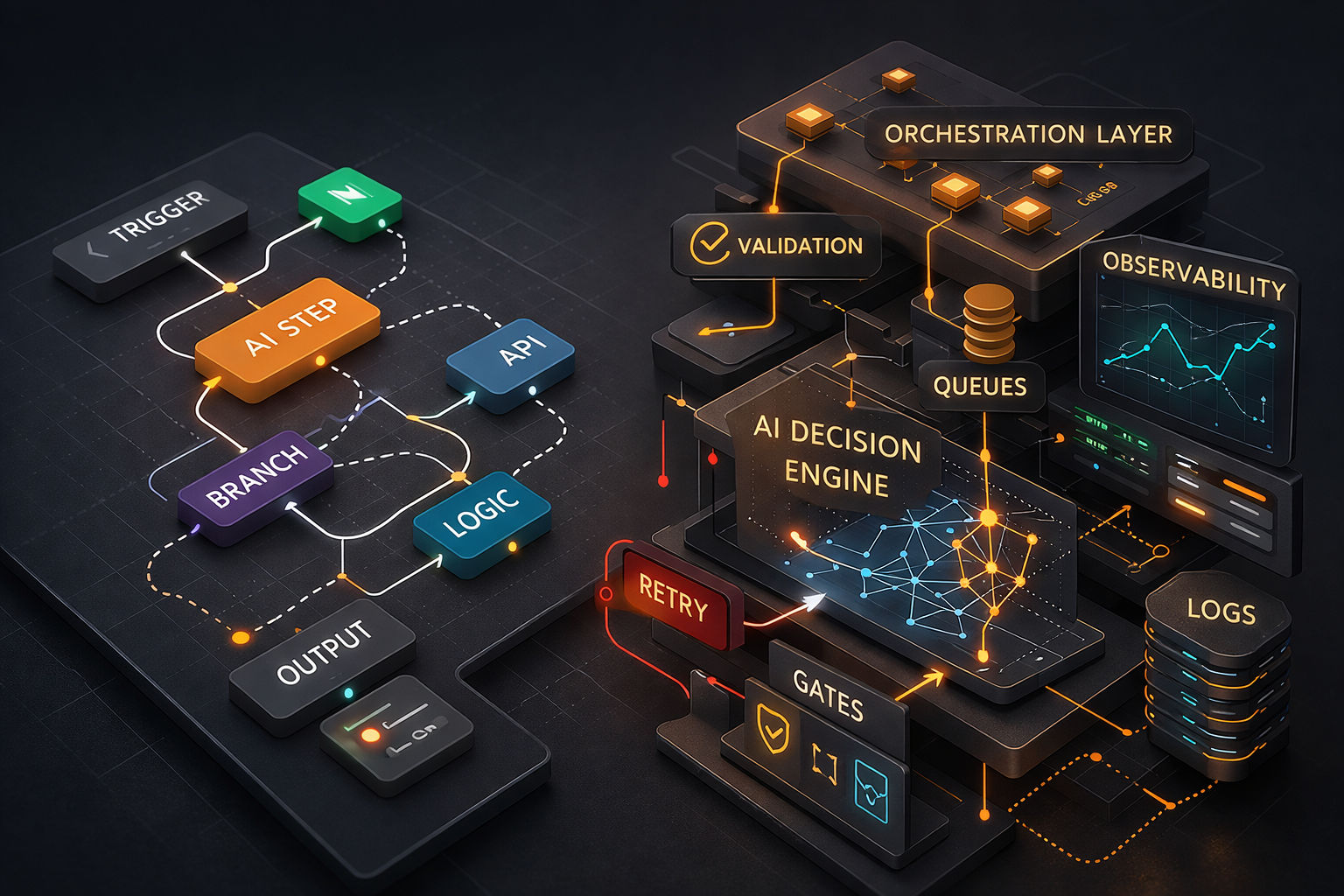
When n8n is a strong fit
n8n is still an excellent choice when:
- The workflow is mostly deterministic.
- The integrations are clear and stable.
- The team needs to iterate quickly.
- The stakes are medium rather than mission-critical.
- One operator can still understand the flow end to end.
That is why I still recommend it for prototypes, internal tooling, and first-pass automation.
Where n8n starts to struggle
1. Complex branching and exception handling
The more edge cases you add, the harder the flow becomes to reason about. A workflow that looked elegant at twelve nodes can become risky at fifty.
2. AI steps that need structure
If models are scoring, classifying, retrieving, or making routing decisions, you need tighter control over schemas, retries, model behavior, and error visibility.
3. Long-running or batch-heavy jobs
Large fan-out processes, scheduled data work, and retry-heavy pipelines usually benefit from explicit queueing and orchestration instead of a visual flow that keeps expanding.
4. Business-critical operational state
If the workflow owns customer state, CRM transitions, billing-sensitive actions, or multi-step approvals, the cost of a silent failure becomes too high.
5. Team maintenance risk
If only one person feels safe editing the workflow, you do not really have a maintainable system. You have a hidden dependency.
What changes in a custom AI workflow
Custom AI workflows let you separate concerns cleanly:
- orchestration
- validation
- AI reasoning steps
- background jobs
- integrations
- observability
That structure matters once the workflow becomes core to revenue or operations.
In our Workflow Intelligence Pipeline case study, the system had to be durable, resumable, and cost-aware. That is the kind of workload where explicit orchestration wins.
The hybrid approach is usually the practical one
This does not need to be an ideological decision.
We often keep a lightweight n8n layer for simple triggers while moving the heavy logic into a custom workflow service. That gives the business fast iteration where it helps and stronger engineering where it matters.
A better question to ask
Instead of asking:
“Can we build this in n8n?”
Ask:
“Will we still feel good about this architecture in six months if the workflow doubles in complexity?”
If the honest answer is no, it is better to plan the rebuild before the automation becomes a source of operational drag.
If your team is already feeling that pain, start with AI Workflow Automation Services and then review the Workflow Intelligence Pipeline case study to see what a stronger orchestration setup looks like.